In the heart of Yangon, where the tropical sun casts long shadows and the air hums with the rhythm of a city both ancient and evolving, two architectural narratives stand in silent, profound dialogue. One speaks of divinity, eternity, and the unwavering faith of a people—the shimmering, golden pinnacle of the Shwedagon Pagoda. The other whispers of a complex, colonial past, its grand but weary facades telling tales of empire, trade, and the indelible marks of foreign rule. This is not a story of opposition, but rather a nuanced conversation between the sacred and the secular, the eternal and the ephemeral, played out in brick, gold, and stone.
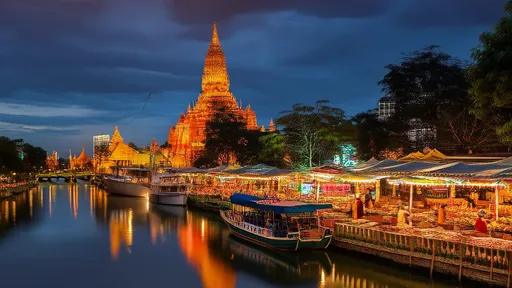
The Shwedagon Pagoda is not merely a structure; it is the soul of Myanmar made visible. Rising 99 meters above the city, its central stupa, encased in genuine gold plates and crowned with a spire laden with thousands of diamonds and other precious gems, is a breathtaking sight. It is believed to enshrine relics of four previous Buddhas, including eight strands of hair from Gautama Buddha himself, making it one of the most sacred sites in the Buddhist world. For centuries, it has been the spiritual compass for the Burmese people, a place of pilgrimage, meditation, and communal gathering. Its light is not just reflected sunlight; to the devout, it is a manifestation of dhamma, the cosmic law and order, a beacon that guides both the heart and the mind toward enlightenment. The pagoda complex is a living entity, constantly maintained and revered, its gold renewed in an ongoing act of collective merit-making. It exists outside of linear time, a symbol of an unbroken cultural and spiritual lineage that has weathered kingdoms, wars, and change.
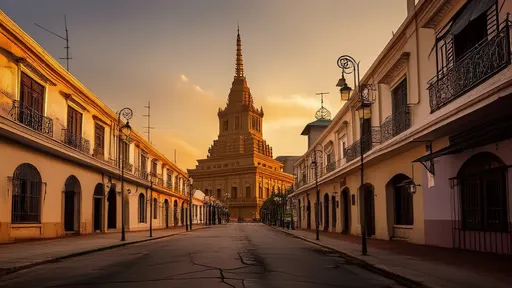
Just a few miles away, in the downtown grid of streets once known as Rangoon, a different history is etched into the cityscape. Here, the grand, albeit fading, edifices from the British colonial era stand as monuments to a different kind of ambition. Constructed primarily during the late 19th and early 20th centuries, these buildings—the former Secretariat, the Strand Hotel, the General Post Office, and countless others—were designed to project the power and permanence of the British Empire. Their architecture is a textbook of colonial style: grand neoclassical and Victorian facades, with high ceilings, wide verandas, and imposing columns intended to cope with the heat while simultaneously awing the local population. They were the engines of administration and commerce, symbols of a system that sought to impose a new order upon the land.
Time, however, has treated these two legacies differently. The Shwedagon’s brilliance is meticulously preserved, its value increasing with each generation's devotion. The colonial buildings, by contrast, bear the patina of neglect and memory. Their plaster cracks, their paint peels, and the tropical climate slowly reclaims the stonework. They are vicissitudes—a Chinese word that perfectly captures a sense of the vicissitudes of time, the melancholy of faded glory, and the weight of history. They are not ruins, but they are no longer pristine. They stand as poignant reminders of an era that was both transformative and traumatic, a period of modernization and subjugation. Their beauty today is a somber one, layered with the complex emotions of a nation still reconciling with its past.
The dialogue between them is most palpable in the space they share—the city itself. From certain vantage points, one can see the golden glow of the Shwedagon hovering above the rooftops, overlooking the grid of streets where colonial-era buildings jostle with modern developments. This visual relationship is a powerful metaphor. The pagoda represents the enduring inner world of Myanmar: its faith, its culture, its core identity. The colonial architecture represents an impactful external force, a historical interruption that became permanently woven into the fabric of the nation. One is vertical, reaching toward the heavens; the other is horizontal, mapping power and commerce onto the earth. They are not arguing but coexisting, each telling a part of the story that makes Yangon the uniquely layered city it is today.
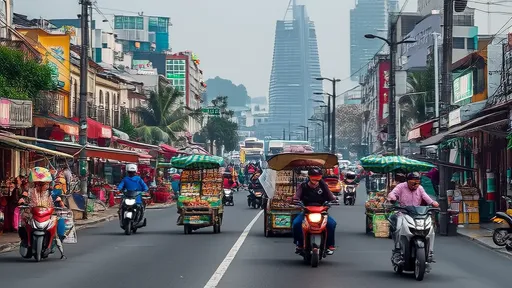
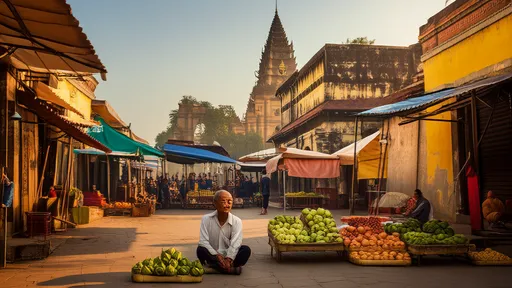
This conversation extends beyond architecture into the very life of the city. Monks in maroon robes walk past the gates of old colonial banks. Traditional tea shops operate on the ground floors of century-old buildings with Corinthian columns. The hustle of modern business happens within frameworks designed for a bygone administration. This is not a city frozen in time, but one where time accumulates, each layer visible and influential. The colonial buildings, in their current state, have been adopted and adapted. They house government offices, art galleries, NGOs, and cafes. They are being rediscovered not as symbols of oppression, but as part of Myanmar's architectural heritage, worthy of preservation and new life. This adaptive reuse is itself a form of dialogue—a way for the present to engage with the past without erasing it.
Ultimately, the radiance of the Shwedagon and the world-weariness of the colonial structures together create the profound depth of Yangon. The pagoda's light offers a sense of constancy and hope, a promise that the essential spirit of the place remains untarnished. The weathered colonial buildings provide a grounding in historical reality, a testament to resilience and the complex journey of a nation. They remind us that cities, like people, are not defined by a single story. They are palimpsests, with pasts written, rewritten, and still visible beneath the surface.
To walk through Yangon is to witness this ongoing, wordless exchange. It is a city that holds both the sublime and the historical in a delicate, powerful balance. The gold of the stupa and the faded ochre of the colonial walls are not in conflict; they are complementary colors on the same canvas, together painting a richer, more complete portrait of Myanmar’s soul—a soul that acknowledges its entire history, embraces its enduring faith, and continues to evolve with quiet, undeniable grace.
By /Sep 3, 2025
By /Sep 3, 2025

By /Sep 3, 2025
By /Sep 3, 2025
By /Sep 3, 2025
By /Sep 3, 2025
By /Sep 3, 2025
By /Sep 3, 2025
By /Sep 3, 2025
By /Sep 3, 2025
By /Sep 3, 2025

By /Sep 3, 2025

By /Sep 3, 2025

By /Sep 3, 2025

By /Sep 3, 2025

By /Sep 3, 2025

By /Sep 3, 2025

By /Sep 3, 2025

By /Sep 3, 2025
By /Sep 3, 2025
