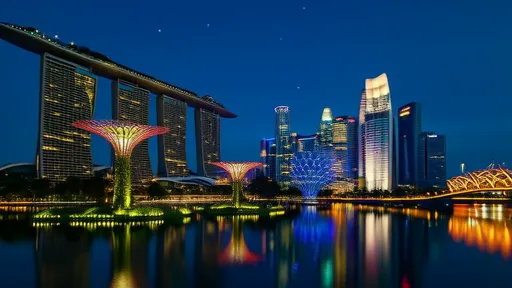
Singapore's Marina Bay stands as a testament to human ingenuity and the relentless pursuit of merging nature with groundbreaking urban design. This iconic district, once a tranquil body of water, has been transformed into a shimmering jewel of Southeast Asia, where futuristic architecture dances harmoniously with lush greenery. It is a place where the line between the built environment and the natural world beautifully blurs, creating an experience that feels both incredibly advanced and soothingly organic. Visitors and residents alike are treated to a spectacle of innovation, a living blueprint for what the sustainable, awe-inspiring cities of tomorrow could aspire to be.
At the very heart of this urban marvel lies the Gardens by the Bay, a sprawling 101-hectare nature park that is far more than just a collection of plants. It is a bold vision of a future where technology and ecology are not adversaries, but partners. The park's most iconic features, the colossal Supertree Grove, are not merely artistic installations; they are vertical gardens performing a vital function. These towering structures, some reaching up to 50 meters in height, are embedded with photovoltaic cells to harvest solar energy, which powers their own light shows and aids in the cooling of the nearby conservatories. They also act as exhausts for the park's massive biomass boilers, a stunning example of form meeting function in the most spectacular way. Walking beneath these giants, especially during the mesmerizing Garden Rhapsody light and sound show in the evening, feels like stepping onto another planet, a surreal forest from a science fiction fantasy brought vividly to life.
Complementing the Supertrees are the two colossal cooled conservatories: the Flower Dome and the Cloud Forest. The Flower Dome replicates the dry, mild Mediterranean climate, housing a breathtaking array of flowers and plants from five continents in what is recognized as the world's largest columnless greenhouse. In stark contrast, the Cloud Forest plunges visitors into the moist, cool air of tropical mountain regions. Here, the world's tallest indoor waterfall cascades down the heart of a mist-covered mountain, surrounded by a vertical garden bursting with orchids, pitcher plants, and ferns. Walking the aerial walkways that skirt the mountain offers breathtaking views and a palpable sense of exploring a lost world, a pristine ecosystem preserved under a glass shell against the backdrop of a modern metropolis.
Rising majestically at the edge of the bay is the Marina Bay Sands integrated resort, an architectural marvel that has become synonymous with Singapore's skyline. Its most distinguishing feature is the Sands SkyPark, a massive, cantilevered platform that crowns the three hotel towers, stretching longer than the Eiffel Tower is tall. This engineering wonder is home to the world's most famous and spectacular infinity pool. Perched 200 meters above the ground, the pool appears to merge seamlessly with the skyline, creating the illusion of swimming on the edge of the world. The experience is nothing short of magical; bathers can float in the cool water while gazing out at a panoramic vista of the financial district, the Singapore Strait, and the lush Gardens below. It is a surreal juxtaposition of ultimate relaxation against a backdrop of powerful urban energy, a place where one can truly feel on top of the world.
The SkyPark is more than just a pool; it is a vast public space in the sky. Alongside the swimming area, a sprawling observation deck offers 360-degree views of the city, allowing those who prefer to stay dry to soak in the same breathtaking scenery. Gardens are integrated into the design, with palm trees and loungers lining the deck, reinforcing that seamless blend of urban luxury and natural tranquility. As day turns to night, the space transforms into a vibrant social hub, with the city lights twinkling like a carpet of stars below. It is a powerful symbol of luxury, innovation, and the human desire to elevate life—literally and figuratively—to new heights.
Beyond these iconic landmarks, Marina Bay is woven together with a commitment to sustainability and livability. The Helix Bridge, with its DNA-like structure, provides a pedestrian link that is itself a work of art, illuminated at night to create a dazzling pathway across the water. The ArtScience Museum, shaped like a lotus flower, embodies the district's core philosophy with its name alone, hosting exhibitions that explore the intersection of creativity, technology, and nature. The bay itself is a reservoir, a vital source of freshwater for the city-state, surrounded by a promenade that invites joggers, cyclists, and families to enjoy the open space against an unforgettable backdrop.
Marina Bay is not a static monument but a dynamic, evolving precinct. It represents a conscious and successful effort to create a district that is not only economically vibrant but also culturally rich and environmentally responsible. It is a place where people work, live, and play in an environment that constantly inspires. The fusion of the奇幻森林 (fantasy forest) of Gardens by the Bay with the gravity-defying aquatic wonder of the Sands SkyPool creates a narrative of a future that is optimistic, sustainable, and profoundly beautiful. It is a masterclass in urban planning, demonstrating that the cities of the future need not be cold, concrete jungles but can be thriving, green, and awe-inspiring habitats that nurture both the planet and the human spirit.
In conclusion, Singapore's Marina Bay is more than just a destination; it is an experience, a vision, and a promise. It challenges conventional notions of urban development and presents a compelling case for a future where nature and technology coexist in spectacular harmony. From the ground-level gardens to the pools in the sky, every element is designed to astonish, engage, and inspire a sense of wonder, firmly establishing this bay-area development as one of the most visionary urban projects of the 21st century.
By /Sep 3, 2025
By /Sep 3, 2025

By /Sep 3, 2025
By /Sep 3, 2025
By /Sep 3, 2025
By /Sep 3, 2025
By /Sep 3, 2025
By /Sep 3, 2025
By /Sep 3, 2025
By /Sep 3, 2025
By /Sep 3, 2025
By /Sep 3, 2025
By /Sep 3, 2025
By /Sep 3, 2025

By /Sep 3, 2025
By /Sep 3, 2025
By /Sep 3, 2025
By /Sep 3, 2025
By /Sep 3, 2025
By /Sep 3, 2025
